
- Chronology
- Before 1500 BCE
- 1500 BCE to 500 BCE
- 500 BCE to 500 CE
- Sixth to Tenth Century
- Eleventh to Fourteenth Century
- Fifteenth Century
- Sixteenth Century
- Seventeenth Century
- Eighteenth Century
- Nineteenth Century
- Twentieth Century
- Twenty-first Century
- Geographic Area
- Africa
- Caribbean
- Central America
- Central and North Asia
- East Asia
- North America
- Northern Europe
- Oceania/Australia
- South America
- South Asia/South East Asia
- Southern Europe and Mediterranean
- West Asia
- Subject, Genre, Media, Artistic Practice
- Aesthetics
- African American/African Diaspora
- Ancient Egyptian/Near Eastern Art
- Ancient Greek/Roman Art
- Architectural History/Urbanism/Historic Preservation
- Art Education/Pedagogy/Art Therapy
- Art of the Ancient Americas
- Artistic Practice/Creativity
- Asian American/Asian Diaspora
- Ceramics/Metals/Fiber Arts/Glass
- Colonial and Modern Latin America
- Comparative
- Conceptual Art
- Decorative Arts
- Design History
- Digital Media/New Media/Web-Based Media
- Digital Scholarship/History
- Drawings/Prints/Work on Paper/Artistc Practice
- Fiber Arts and Textiles
- Film/Video/Animation
- Folk Art/Vernacular Art
- Genders/Sexualities/Feminisms
- Graphic/Industrial/Object Design
- Indigenous Peoples
- Installation/Environmental Art
- Islamic Art
- Latinx
- Material Culture
- Multimedia/Intermedia
- Museum Practice/Museum Studies/Curatorial Studies/Arts Administration
- Native American/First Nations
- Painting
- Patronage, Art Collecting
- Performance Art/Performance Studies/Public Practice
- Photography
- Politics/Economics
- Queer/Gay Art
- Race/Ethnicity
- Religion/Cosmology/Spirituality
- Sculpture
- Sound Art
- Survey
- Theory/Historiography/Methodology
- Visual Studies
The Arts in Latin America, 1492–1820 was a splendid exhibition covering the period from the time Columbus arrived until the moment when emerging nations from Chile to Mexico moved toward independence. Showing it in three dramatically different venues—Philadelphia, Mexico City, and Los Angeles—resulted in three profoundly different statements. In Philadelphia one simply gasped to see such luxury from so many fabulously wealthy colonies (mostly Spanish and Portuguese). When visitors walked through the Mexican show, however, they noticed something different: a preponderance of Mexican works, with the less numerous objects from the Andes, Brazil, and other nations positioned as if to frame the national pieces. Los Angeles was different still: though the Mexican-American population is immense, that exhibition replicated the politically remote overview of the Philadelphia show. Yet that distance, in this case from the local latino audience, sparked reaction.
It is important to realize that the works in each venue were not the same objects arranged in different ways: like a fresh cast of actors for a play, the items themselves changed more than usually happens when an exhibition travels: Mexico added an unusual number of major works that were available only there. In Los Angeles one saw a distilled version of the Philadelphia cast of objects, and the quantity of new works was within normal limits for a traveling show.
These different locales sought to emphasize objects from the days of colonial rule, and they did a superb job of fulfilling that ambition. But each location also demonstrated its own position vis-à-vis the notion of Latin America. To give a sense of these differences, I will review each venue in detail.
Philadelphia showed the largest quantity of works, just under three hundred. Such a celebratory number of objects announced that this was high art, not folk craft, and the selection avoided the modernist pitfall of privileging painting as the most valuable medium, giving equal emphasis to sculpture and the luxury arts. This was appropriate, because the statues, furniture, ceramics, silver, textiles, and small items for private pleasure laid out a telling picture of these sophisticated societies.
This was the Philadelphia Museum at a moment just before the opening of the new Perelman Building in fall 2007, an addition that provides the venerable older structure much-needed space. In 2006 the panoply of Latin American art had to be installed in galleries that were too small. A display strategy thus made the exhibition a collection of Tesoros/Treasures/Tesouros (as the Philadelphia stop was banner-titled) and exploited the sense of a tumbling treasure trove, a deliberate pileup of precious objects. This idea was underscored by sometimes hanging paintings one on top of another from floor to ceiling or by surrounding the delighted but disoriented viewer with a crowd of lifelike polychrome sculptures. Curator Joseph Rishel along with Suzanne Stratton-Pruitt sought a dazzling effect, and for most visitors it worked: the senses were bombarded.
Occasionally a complaint was heard that the exhibition should have been more didactic, emphasizing categories so that novices could learn. Yet such divisions would have depended on a consensus in the scholarship, and as I will discuss, even the most foundational concept in this developing field, namely the existence of a cultural region called Latin America, remains controversial. A didactic approach would have dumbed down the intellectual diversity that was better imaged by the exhibition’s vertiginous array of objects.
Just outside the entrance to the galleries, the architectural treasure Crucifix and Rood Screen, probably by José Gomes de Figueiredo with an unknown sculptor in 1783–92, stopped viewers in their tracks. From the Monastery of São Bento in Olinda, Pernambuco, Brazil, the ensemble was newly restored for the exhibition, and Christ’s body was placed against a gilded sunburst, seeming to hang incomprehensibly in a dark void until a delicate arch and two columns stabilized the vision. Upon entering the hall to the first gallery, another object demanded a different response: an archaeological fragment required slow and sober inspection. The column base depicting Tlaltecuhtli, Lord of the Earth, imaged a combination of spolia from the pre-Conquest precinct of Tenochtitlán in Mexico City, first carved in 1325–1521, then re-used in 1537–1650 for a Spanish colonial building.
The first full gallery then demanded another switch of sensibility, now inviting exceptionally close inspection of a sixteenth-century Peruvian tunic from Lake Titicaca with its astonishingly precise weaving. Among the paintings, some of the most significant were a set of casta scenes by Miguel Cabrera from 1763, figuring race and rank in family groups. Scattered throughout was another category typical of the Southern hemisphere: formal portraits of Viceregal courtiers, making the necessary point that the majority of patrons were not the indigenous inhabitants but the monied criollos or Creoles, who were born in the colonies but who had themselves immortalized in imitation of Spanish and French aristocrats. In general a wide selection of media was seen in Philadelphia, because the curators invited a diverse group of scholars, including myself, to contribute essays and expertise.
When I was a graduate student in the late 1960s, I inquired about courses on Latin American art. “Why do you want to study that?” came the response. “It’s just provincial Spanish.” My advisors should have lived to see this exhibition, which makes it clear that Latin American art is neither provincial nor just Spanish. Among the most welcome points in Philadelphia was that Latin Americans were serious consumers of goods from China, Japan, the Philippines, and the Indian subcontinent, and that Latin artists had integrated Asian markers into their own developing arts well before the English and French began such appropriation. In Philadelphia a Mexican wardrobe reproduced chinoiserie patterns that came first as a fad to the Americas, not to Europe; a desk inlaid with tortoiseshell and mother-of-pearl displayed familiarity with the seventeenth-century Korean Chosŏn style. Biombos or folding screens were adapted from Japan.
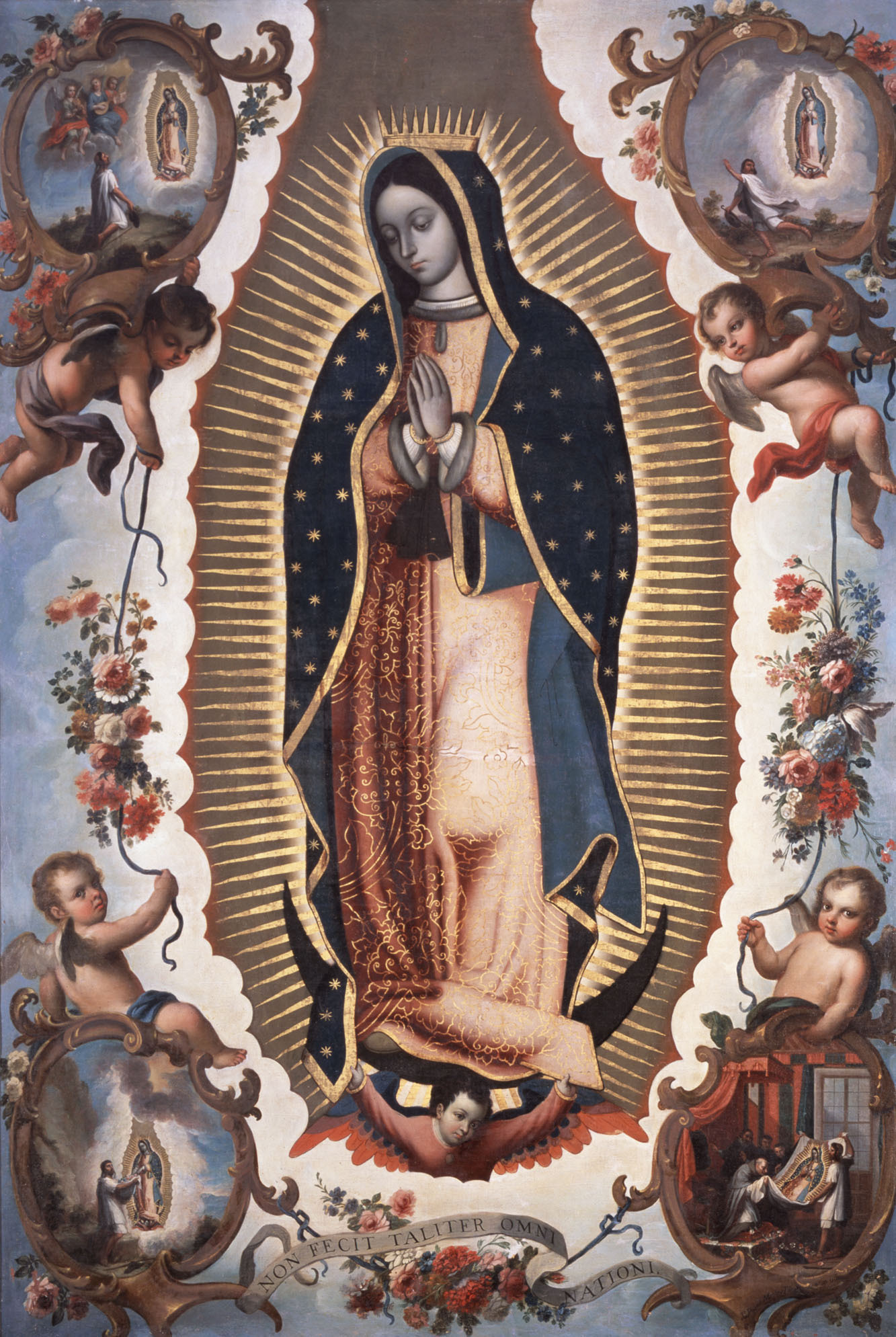
In its idealism, The Arts in Latin America, 1492–1820 was courageous because each loan from each separate institution in each different country had to be negotiated separately. The curatorial team in Philadelphia began with a dream instead of an array of financial backers with political connections. By contrast, the great Mexico: Splendors of Thirty Centuries at the Metropolitan Museum in 1990 began with a single country and powerful sponsors who could guarantee the loan of specific objects from the beginning. The price of Philadelphia’s courage was that the catalogue occasionally published a work that did not make it to this first unveiling, and sometimes never made it to any venue. Yet some works in the Philadelphia catalogue did show up in Mexico City, such as the large and beautifully restored Juan Patricio Morlete Ruíz Virgin of Guadalupe (mid-eighteenth century), of which more below.
If Philadelphia had to adapt to twentieth-century galleries that were too small, Mexico City was blessed with the ideally spacious setting. The galleries in the eighteenth-century Antiguo Colegio de San Ildefonso were perfectly congenial to works like Gaspar Miguel de Berrio’s Patronage of St. Joseph of 1737. Although visually rewarding in its vivid, jewel-like colors, it was nonetheless bewildering in a modern gallery, representing a multitude of personages who must have delighted the ecclesiastical bureaucrats in Bolivia when they commissioned it, but that left viewers today confused and excluded. In the chapel, its hermetic pomp and reverence suddenly felt right.
National identity can never be detached from the notions one nation projects onto another, and this is the challenge colonial Latin America presents to residents of the United States. Morlete Ruíz’s Virgin of Guadalupe possesses characteristics that might once have been called “provincial,” but the huge painting now seems to turn that label on its head. In the Italian description of art that originated in the Renaissance, a correctly illusionistic drapery should obey rules. If the Virgin’s red cloak shows gold filigree embroidery on its fabric’s top layer, that embroidery should end where the cloak ends; if the gold is a detachable metallic scarf, then it should be legible as such. Morlete Ruíz places this splendid Guadalupana not in the rational world of disegno but in an ambiguous dimension that detaches the filament from the fabric and allows the pattern to extend beyond the limits of the cloak so that it flows onward—perhaps in flagrant violation of European standards but perhaps not—to decorate a completely different pink gown. Perhaps this was once seen as the “folk stylization” and “disarming naiveté" that Martin Soria found in Latin Colonial painting in 1959 (George Kubler and Martin Soria, Art and Architecture in Spain and Portugal and Their American Dominions, 1500–1800, Baltimore: Penguin Books, 1959, 303). Yet today we would say that by appropriating the Virgin’s European wardrobe but substituting Mexican rules for its description, Morlete Ruiz unmasks the status of both traditions as equally local. Seen with global eyes in 2006–07, the painting also suggests that the grounding principles of Western illusionism could be said to be literal to the point of dullness, so formulaic that they lack imagination. In Mexico City this huge canvas was centrally displayed, and the drapery was so thoroughly illuminated that its techniques were intriguingly visible.
The common title of all three exhibitions, The Arts in Latin America, implies that Latin America is a unified place with a common identity. Residents of the United States who have not lived in Latin America unconsciously assume that its many countries are comparable to states, as if Guatemala were like Vermont, or Chile were similar to Florida. Citizens of these Latin American nations are keenly aware, however, that even within their borders they are a mixture of tribes that had different languages and cultures before the Conquest, and that their putative unity can be seen as a fiction imposed by the European empires that conquered and renamed them.
Such issues were not explicitly raised in Mexico City, but in the display hierarchy Mexican works took pride of place, and works from the rest of Latin America seemed present in diminished proportion, especially because a significant quantity of Mexican items had been prominently added. In Philadelphia the exhibition aimed at a balanced representation of all nations included. In Mexico it became a Mexican show. This is not to say that there was no effort at a pan-Latin American statement, as when the organizers invited the Peruvian Mario Vargas Llosa to write the prologue to the catalogue. The change of focus was entirely logical for a show in Mexico City, but its radical difference from the North American venues should be noticed.
In Mexico City the curators, Clara Bargellini and Ery Cámara, did not simply translate the Philadelphia catalogue, though many essays and entries were reproduced in Spanish. Instead they renamed their show Revelaciones and produced a new catalogue that included works shown only in Mexico alongside a selection also displayed in Philadelphia. In any multi-site exhibition, some works drop out after the first showing, but in Mexico City the curators took full advantage of that fact of museum life, redefining the scope and meaning of the exhibition. Unlike the U.S. venues, Mexico also explored the beginnings of a postcolonial sensibility in works like Portrait of Captain Pedro Marcos Gutiérrez and His Family of 1814, where the poses and costumes showed an upper-class family linking itself to the bourgeois.
In Los Angeles the exhibition returned to its original title, The Arts in Latin America, 1492–1820. This was the North American version as seen in Philadelphia, but reduced, refined, and focused. Although smaller, it was beautifully designed and installed, so that one moved organically from one gallery to another. A few works were added by curator Ilona Katzew, but they did not shift the concept, reaffirming the premise of a coherent Latin America. A subtle but intelligent sense of divisions in subject matter governed the placement of works. A gallery was devoted to videos of sacred statues carried in procession in the Andes, and this social context was moving. Display techniques added details to deepen the meaning of the works for the educated visitor. For example, the wall map at the start of the exhibition was updated from the catalogue, with the dates of the major viceroyalties added; labels for individual works were edged with marginalia reproduced from historic books printed in the colonies; a print by Jacobus de Gheyn II was reproduced within the label for a painting of a militant archangel, showing the European ancestry of these seemingly Bolivian renderings of balletic soldiers dressed in gold lace.
Despite the harmonious visual presentation of the works at the Los Angeles County Museum, and the sensitive addition of contextual detail, the show initially provoked local disagreement. Christopher Knight of the Los Angeles Times pronounced that “it’s easily the most important exhibition in Los Angeles this year” (Calendar Desk, part E, 1, August 4). But it also drew fire because at first it offered no Spanish-language catalogue or wall texts: “Art from the Spanish world, not in Spanish,” complained Daniel Hernández (Intersections. a blog from Los Angeles, 07 August 2007). Museum professionals defend that last decision because they know that extensive wall labels tempt visitors to read the texts instead of looking at the art. But within weeks the Spanish catalogue from Mexico City, Revelaciones, became available, and complaints ceased. One suspects the negative reaction had less to do with what the museum did than with the fact that this transpired in Los Angeles, not in Philadelphia, which also lacked a Spanish catalogue but where the status of latino versus anglo culture was not an issue.
The three venues of The Arts of Latin America, 1492–1820 offered three very different stagings of the works, and each museum revealed its own viewpoint, however inadvertently. The sense of a beautiful whole with consistent parts, of Latin America as a concept that made visual and historical sense, informed the original concept of the exhibition as conceived in Philadelphia. That idea of wholeness as opposed to separation in national identities was examined again in Mexico City, and was shifted by adding Mexican objects and by publishing a new catalogue in Spanish. Los Angeles enacted a third issue, not in the objects, but in the local reaction to them. Significantly, the value of the arts from Latin America was not controversial anywhere, and no one argued over whether they were worth showing. But in underlining questions such as who spoke for the art, and in what language, Mexico City reaffirmed its national identity, and Los Angeles represented itself as the United States’ metropolis of latinidad.
Gridley McKim-Smith
Andrew W. Mellon Professor in the Humanities, Department of History of Art, Bryn Mawr College